Let me be frank.
Most people online throw around AI terms without actually understanding what they mean. They talk about ChatGPT, AI tools, and automation like experts, but the moment someone mentions terms like “context window” or “temperature,” the conversation suddenly becomes very quiet.
You do not need to become an AI engineer to understand modern AI.
You just need to understand the right concepts.
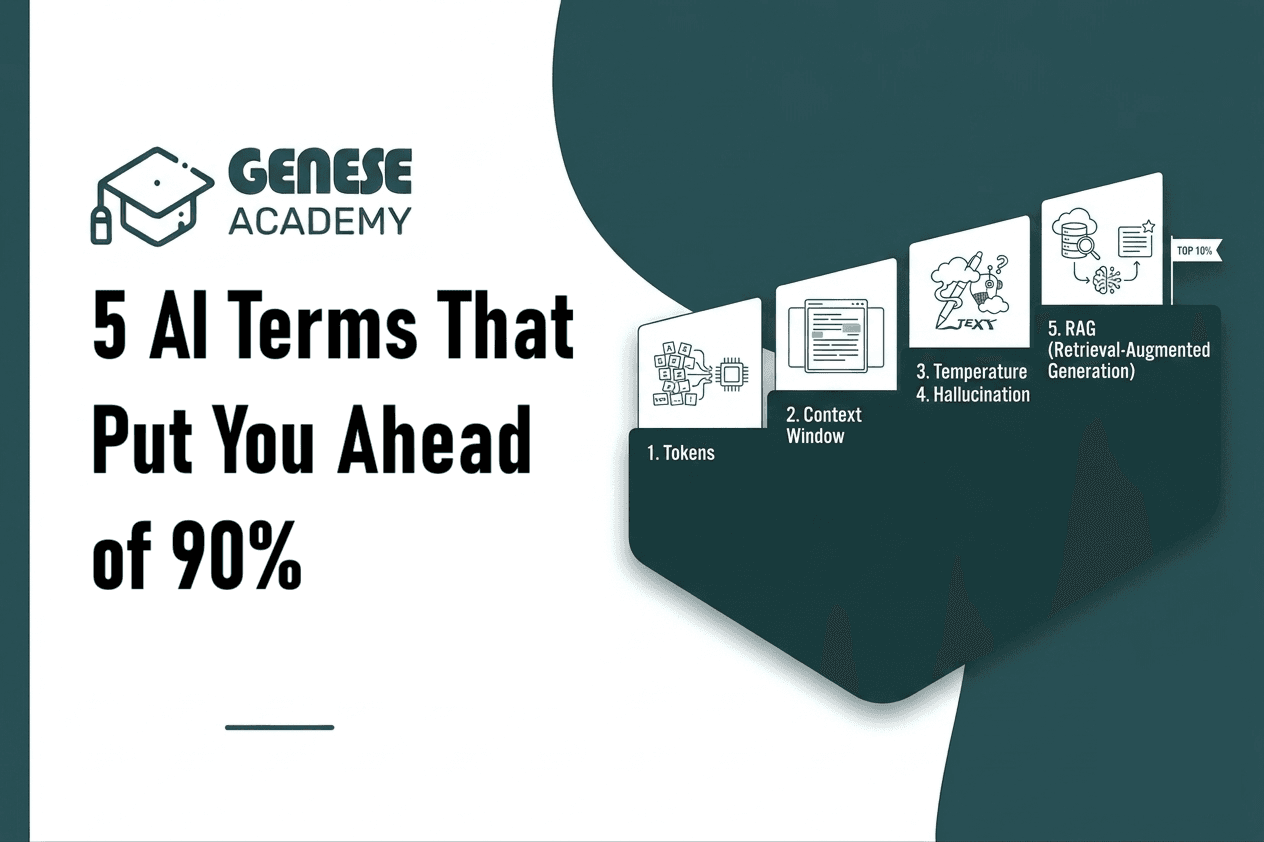
And honestly, if you understand these 5 AI terms properly, you are already ahead of most people talking about AI in 2026.
This guide by Genese Academy explains these concepts in the simplest way possible so beginners can understand how modern AI systems actually work.
1. Tokens
The first thing you need to understand is tokens.
AI does not read text the way humans do. Instead of reading complete sentences, AI breaks text into smaller chunks called tokens.
A token can be:
- A word
- Part of a word
- A punctuation mark
- A symbol
For example, a long word might be split into multiple tokens before the AI processes it.
Every question you ask ChatGPT uses tokens.
Every response generated by AI also uses tokens.
The more tokens involved, the more memory and processing power the AI needs.
This is why AI systems often have token limits.
Once you understand tokens, you start understanding how AI actually processes language behind the scenes.
2. Context Window
This is one of the most underrated AI concepts.
A context window is basically the amount of information an AI model can remember during a conversation.
Think of it like the AI’s short-term memory.
If the context window is small, the AI may forget earlier parts of the conversation quickly.
If the context window is large, the AI can remember more instructions, details, and previous messages.
This is why newer AI models feel smarter and more consistent.
They can “remember” more context while generating responses.
For example:
- Long conversations
- Large documents
- Coding projects
- Research tasks
all depend heavily on context windows.
The larger the context window, the better the AI handles complex tasks.
3. Temperature
Now this term sounds scientific, but the idea is surprisingly simple.
Temperature controls how creative or predictable an AI response becomes.
Low temperature means:
- More focused responses
- More predictable answers
- Less creativity
High temperature means:
- More creative responses
- More randomness
- More unexpected outputs
For example:
If you ask AI to solve a math problem, you usually want low temperature because accuracy matters.
But if you ask AI to write a creative story or marketing idea, higher temperature can produce more interesting results.
So temperature is basically the creativity control system of AI.
4. Hallucination
This is one of the biggest problems in AI today.
AI hallucination happens when an AI confidently gives false or completely made-up information.
And the scary part?
Sometimes the answer sounds extremely convincing.
The AI may invent:
- Fake facts
- Fake statistics
- Fake sources
- Incorrect explanations
not because it wants to lie, but because AI predicts patterns instead of truly understanding reality.
This is why fact-checking AI responses is extremely important, especially for:
- Research
- Medical information
- News
- Academic work
- Business decisions
AI is powerful, but it is not always accurate.
Understanding hallucinations helps people use AI more responsibly.
5. RAG (Retrieval-Augmented Generation)
This sounds complicated, but it is actually one of the smartest AI improvements today.
RAG stands for Retrieval-Augmented Generation.
Here is the simple version:
Instead of relying only on trained memory, the AI first searches trusted external information before generating a response.
That extra retrieval step helps the AI produce:
- More accurate answers
- Updated information
- Better factual responses
- Fewer hallucinations
This is becoming extremely important because AI models alone cannot always stay updated with real-time information.
RAG systems help AI connect to:
- Databases
- Documents
- Company files
- Websites
- External knowledge sources
This makes modern AI tools much more reliable.
Why These 5 AI Terms Matter
Most people only use AI tools.
Very few people understand how those tools actually work.
But the people who understand these concepts are usually the ones who adapt faster, learn faster, and stay ahead of technology trends.
Because AI is no longer future technology.
It is current technology.
Students are using it.
Businesses are using it.
Content creators are using it.
Developers are building entire companies around it.
And in 2026, understanding AI basics is quickly becoming a real-world skill.
Final Thoughts
You do not need a computer science degree to understand AI.
But understanding tokens, context windows, temperature, hallucinations, and RAG already puts you ahead of most people discussing AI online.
These are not just technical buzzwords anymore.
They are the foundation of how modern AI systems work.
And the sooner you understand them, the better prepared you will be for the future digital world.