
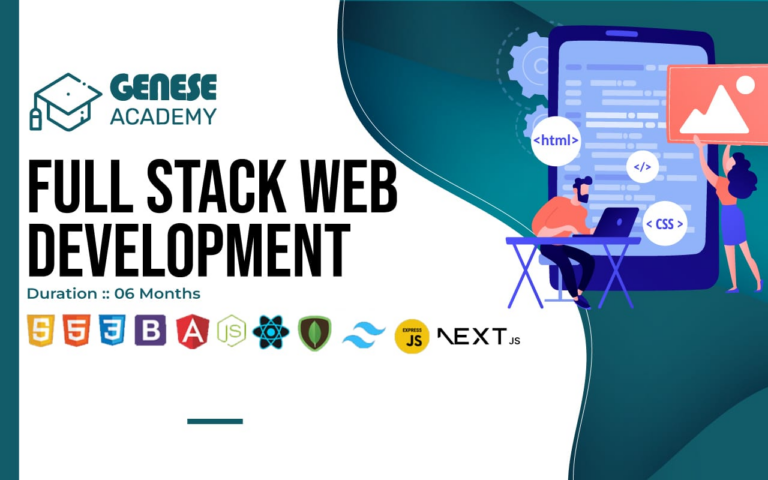
FULL STACK WEB DEVELOPMENT
8
1
06 Months
Full Stack Web Development – Complete Overview
What is Full Stack Web Development?
Full Stack Web Development is the process of building complete websites and web applications by working on both the front-end (client side) and back-end (server side). A full stack developer has the skills to design user interfaces as well as manage databases, servers, and application logic.
Front-End Development
Front-end development focuses on the visual and interactive part of a website that users see and use. It involves technologies like HTML, CSS, JavaScript, and modern frameworks such as React or Vue. The goal is to create responsive, user-friendly, and attractive interfaces.
Back-End Development
Back-end development handles the server, database, and application functionality. It ensures that the website works properly behind the scenes. Common technologies include Node.js, Express.js, PHP, Python, and databases like MongoDB and MySQL.
Database Management
Databases are used to store, manage, and retrieve data efficiently. Full stack developers work with databases to handle user data, application data, and system operations. Popular databases include MongoDB, MySQL, and PostgreSQL.
Key Skills Required
Full stack developers need a mix of technical and problem-solving skills, including programming, database management, API integration, debugging, and understanding of both front-end and back-end technologies.
Importance of Full Stack Development
Full Stack Web Development is highly in demand because businesses need complete web solutions. A full stack developer can handle entire projects, making development faster, more efficient, and cost-effective.
Learning at Pakistan No.1 IT Training Institute
At our Pakistan No.1 IT Training Institute in Arfa Tower, Lahore, students receive professional and practical training in Full Stack Web Development. We focus on hands-on projects, modern technologies, and real-world applications to prepare learners for freelancing, jobs, and successful careers in the global tech industry.
Conclusion
Full Stack Web Development is a powerful and versatile skill that opens doors to many career opportunities. With proper training and consistent practice, students can build advanced web applications and succeed in the fast-growing digital world.
Key Takeaways – Full Stack Web Development
- Covers both front-end (UI/UX) and back-end (server, database) development
- Uses core technologies like HTML, CSS, JavaScript for front-end
- Back-end built with Node.js, PHP, Python, Java and databases like MySQL, MongoDB
- Focuses on building complete, functional web applications
- Involves API integration for communication between systems
- Requires knowledge of version control (Git) and deployment
- Supports development of dynamic, scalable, and responsive websites
- Widely used in e-commerce, social media, business platforms, and SaaS applications
- Full stack developers can handle end-to-end project development
- High demand skill in the modern IT industry
Who Should Attend – Full Stack Web Development
- Students (Matric, Inter, Graduation) who want to start a career in IT
- Beginners with no prior coding experience
- Individuals interested in website and web application development
- Freelancers who want to offer web development services
- Job seekers looking to enter the software development field
- Graphic designers who want to upgrade to development skills
- Entrepreneurs who want to build their own websites or startups
- IT professionals who want to expand their skill set
- Anyone interested in learning front-end and back-end technologies
Meet Our Instructor

ESHA ZEHRA
Ms. Esha Zehra is a Full Stack Web Development instructor with expertise in modern frontend and backend technologies. She has strong hands-on experience in building scalable applications, developing user interfaces, and managing server-side systems. Her teaching style is practical and easy to follow, focused on real-world projects and clear understanding. She helps learners develop skills in web development, database management, and application architecture. Her goal is to prepare students with industry-ready skills to confidently build and deploy web applications.
Skills Covered
- Front-End Development
- Front-End Development
- Back-End Development
- Back-End Development
- Full-Stack Development
- Full-Stack Development
- Responsive Web Design
- Responsive Web Design
- JavaScript Development
- JavaScript Development
- MERN Stack Development
- MERN Stack Development
- UI Development
- UI Development
- Web Application Development
- Web Application Development
- API Development & Integration
- API Development & Integration
- Database Management
- Database Management
Tools Covered


Full-stack Course Syllabus
- Introduction to Web Technologies & HTTP Protocols
- HTML5: Semantic Elements, Forms, and Media
- CSS3: Advanced Styling, Flexbox, and CSS Grid
- Creating Responsive Layouts with Bootstrap 5
- Design Principles for Modern Web Interfaces
- JavaScript Essentials: Variables, Data Types & Operators
- Control Structures: Loops, Conditionals & Logic
- DOM Manipulation & Event Handling
- Modern ES6+ Features: Arrow Functions & Promises
- Asynchronous Programming & Fetching APIs
- Introduction to React.js: Components & JSX
- State Management: use State, use Effect & Context API
- Routing & Navigation in Single Page Applications (SPA)
- Introduction to Angular Architecture & TypeScript
- Building Dynamic User Interfaces with Angular Modules
- Core PHP Programming: Syntax & Logic
- Working with Arrays, Strings & Regular Expressions
- Reusing Code: Functions, require() and include()
- Introduction to Python: Scripting for Web Automation
- Object-Oriented Programming (OOP) in PHP & Python
- Relational Database Concepts & Normalization
- Designing Web Databases with MySQL
- SQL Queries: CRUD Operations, Joins & Indexing
- Database Security & User Authentication
- Introduction to MVC Architecture & Laravel Installation
- Blade Templating Engine with Bootstrap Integration
- Eloquent ORM: Working with Models & Migrations
- Handling Requests, Controllers & Form Validation
- Building a Complete Professional Web Application
- Full-Stack Project Integration (Frontend + Backend)
- Version Control with Git & GitHub Collaboration
- Deploying Applications to AWS / Live Hosting Servers
- Domain Mapping, SSL Integration & Performance Optimization
- Final Portfolio Presentation & Job Placement Readiness
Job Success Stories
- Success Story

Ayesha Web Developer Success Story: How She Built a Professional Tech Career with Genese Academy
Ayesha Khalid Success Story — From Beginner to Professional Web Developer at Genese Academy Lahore
- Full Stack Web Development
- 1000$
- Success Story

Ali Hassan
Social Media Manager Success Story: How Ali Earns $500 Monthly Social Media Manager Success Story
- Digital Marketing
- 500 USD
FAQS
No. The course begins with fundamental concepts and progressively advances to full stack development and AI integration, making it suitable for beginners as well as learners looking to upskill.
Yes. Participants will be awarded a course completion certificate by GENESE ACADEMY based on successful evaluation of the final exam and project.
Yes. The course equips students with in-demand full stack skills, enabling them to work with clients, pursue remote opportunities, or build their own projects.
Genese Academy offers expert-led training, hands-on project-based learning, and structured guidance to help students build strong portfolios and prepare for real-world development roles.
The course emphasizes hands-on implementation, with live demonstrations and guided practice during sessions to ensure strong conceptual clarity and real-world application.
Yes. Upon successful completion of the course and evaluation of your performance, students are provided internship opportunities.