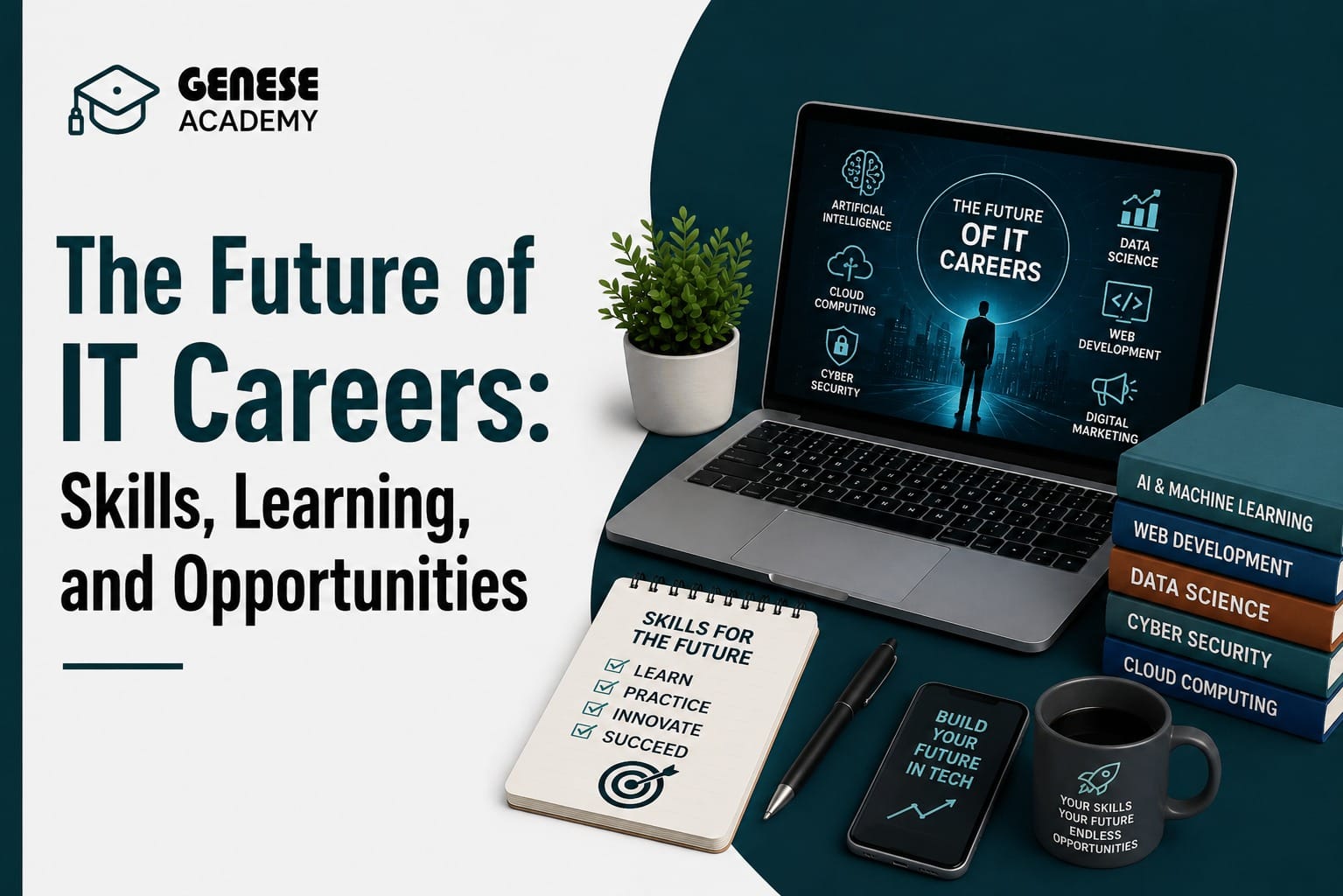
Technology is no longer limited to software companies or IT departments. Today, almost every business relies on technology in some way—from websites and mobile applications to cloud systems, digital marketing, artificial intelligence, and cybersecurity.
As technology continues to evolve, the way people build careers is changing too. New roles are emerging, existing jobs are becoming more technology-driven, and employers are increasingly looking for people who can apply practical skills, not just understand theory.
For students, fresh graduates, and professionals considering a career change, this creates an important question:
Which IT skills are worth learning for the future?
Why Are IT Careers Becoming More Important?
Think about how many businesses depend on technology today.
A restaurant may need an online ordering system. A clothing brand may rely on social media and e-commerce. A company may need secure networks and cloud infrastructure. A startup may need developers to build its product.
Behind all of these services are people with different technical and creative skills.
Some of the areas creating career opportunities include:
- Artificial Intelligence
- Machine Learning
- Data Science
- Web Development
- Cybersecurity
- Cloud Computing
- DevOps
- Digital Marketing
- UI/UX Design
- Graphic Designing
- E-Commerce
This doesn’t mean everyone needs to learn all of them. In fact, trying to learn everything at once can make it harder to become good at anything.
A better approach is to identify an area that matches your interests and career goals, then develop practical skills in that direction.
Essential IT Skills for the Future
1. Artificial Intelligence and Machine Learning
Artificial Intelligence has moved from being a futuristic concept to becoming part of everyday technology.
AI is being used for automation, customer support, data analysis, content creation, recommendation systems, and many other applications.
Learning the fundamentals of AI and Machine Learning can help students understand how intelligent systems work and how these technologies can be applied to real-world problems.
The important thing is not simply learning about AI. It’s learning how to use it effectively and build with it.
2. Web Development
Almost every modern business needs a digital presence, and many businesses require much more than a basic website.
Web developers build websites, web applications, dashboards, e-commerce platforms, and other digital products.
Learning technologies such as HTML, CSS, JavaScript, modern frameworks, backend development, and databases can provide a strong foundation for anyone interested in building digital products.
Web development can also open doors to employment, freelance projects, remote work, and entrepreneurship.
3. Cybersecurity
The more organizations depend on digital systems, the more important security becomes.
Businesses store customer information, financial data, internal documents, and other sensitive information online. Protecting these systems requires people who understand networks, vulnerabilities, security practices, and potential threats.
Cybersecurity is therefore not simply about preventing attacks. It is about understanding how systems can be protected and how security weaknesses can be identified and addressed.
4. Data Science
Businesses collect enormous amounts of information, but data is only valuable when organizations can understand it.
Data Science combines areas such as programming, statistics, data analysis, visualization, and Machine Learning to turn raw information into useful insights.
For someone who enjoys working with numbers, patterns, and problem-solving, Data Science can be an interesting career direction.
5. Cloud Computing and DevOps
The way companies build and manage software has changed significantly with cloud technology.
Cloud platforms allow businesses to use computing resources, storage, databases, and other infrastructure without relying entirely on physical systems.
DevOps, meanwhile, focuses on improving the way software is developed, tested, deployed, and maintained.
Learning technologies related to Cloud Computing, AWS, and DevOps can help IT professionals understand the infrastructure behind modern applications and services.
Why Practical Learning Matters
Knowing something in theory is different from being able to use it.
You might understand how a website works, but can you build one?
You might know the principles of graphic design, but can you create a complete design project?
You might understand cybersecurity concepts, but can you apply them in a controlled practical environment?
This is why practical learning matters.
Working on projects allows learners to:
- Apply what they have studied
- Develop problem-solving skills
- Understand how tools work in real situations
- Build confidence
- Create portfolio projects
- Discover their strengths and weaknesses
- Become more familiar with industry workflows
A portfolio can also give employers or clients something tangible to evaluate.
Instead of simply saying “I know this skill,” you can show what you have actually created.
IT Skills Can Lead to Different Career Paths
One of the biggest advantages of developing digital skills is the number of directions you can take.
Employment
Companies across different industries need developers, designers, marketers, cybersecurity professionals, data specialists, and other technology-focused roles.
Freelancing
Digital skills can also be used to provide services to clients. Web development, graphic design, video editing, digital marketing, and other skills can be offered through freelance platforms or direct client relationships.
Remote Work
Many technology-related roles can be performed remotely. This means skilled professionals may have opportunities to work with companies outside their immediate location.
Entrepreneurship
Technology can also help people create their own businesses.
A developer can build a web application. A designer can start a creative service. A marketer can help businesses grow online. An e-commerce professional can build and manage an online store.
The possibilities depend heavily on the skill you develop and how effectively you use it.
How Should You Choose the Right IT Course?
With so many options available, choosing a course can be confusing.
The most popular course isn’t necessarily the right one for you.
Start by asking yourself what type of work you actually enjoy.
Do you enjoy coding and problem-solving?
Web Development, Python, AI, or Data Science may be worth exploring.
Interested in digital security and technology?
Cybersecurity could be a suitable direction.
More interested in creativity and visual work?
Graphic Designing, UI/UX Design, or Video Editing may be a better fit.
Interested in business and online growth?
Digital Marketing, SEO, or E-Commerce could be relevant.
Before enrolling in a course, consider:
- Does the subject genuinely interest you?
- Does the course cover practical skills?
- Will you work on projects?
- Can you build a portfolio from what you learn?
- Does the skill match your long-term career goals?
These questions can help you make a more informed decision.
You Don’t Have to Know Everything
One of the biggest mistakes beginners make is thinking they need to learn every technology before starting a career.
You don’t.
Technology is too broad for anyone to master everything.
Instead, choose one area, learn its fundamentals, practice consistently, and gradually expand your knowledge.
For example, someone starting with web development doesn’t need to learn every programming language. They can begin with the fundamentals, build projects, understand how the different parts of web development work together, and then move toward more advanced technologies.
Depth in one useful skill is often more valuable than shallow knowledge of ten different skills.
Continuous Learning Is Part of an IT Career
Technology doesn’t stand still.
Tools change. Software gets updated. New platforms appear. Artificial Intelligence continues to influence different industries, and businesses constantly adopt new ways of working.
That means learning shouldn’t stop when you finish a course.
Successful technology professionals continue learning through:
- Personal projects
- Advanced courses
- Workshops
- Certifications
- Industry resources
- Practical experimentation
- Professional communities
You don’t need to chase every new trend. The goal is to build strong fundamentals and then keep updating your knowledge as your field develops.
Learning Practical IT Skills at Genese Academy
If you’re looking for an IT training institute in Lahore, choosing a learning environment that matches your goals can make the process easier.
Genese Academy offers courses across several technology, creative, and professional fields, allowing learners to explore different career directions based on their interests.
Some of the areas include:
- Artificial Intelligence
- Data Science
- Full Stack Web Development
- Cyber Security & Ethical Hacking
- Cloud Computing
- Digital Marketing
- Graphic Designing
- UI/UX Designing
- E-Commerce
- Video Editing
- Animation
- Networking
Whether your goal is to prepare for employment, develop freelance skills, or build your own digital project, the most important step is to choose a skill and actually practice it.
What Will IT Careers Look Like in the Future?
Nobody can predict exactly what the technology industry will look like several years from now.
However, one thing is becoming increasingly clear: the ability to learn and adapt is becoming a valuable career skill itself.
Some specific tools may become outdated, but the ability to solve problems, understand technology, communicate ideas, work with digital tools, and learn new systems can continue to be useful.
The future isn’t necessarily about knowing one particular software or programming language.
It’s about becoming someone who can learn, adapt, and build.
Final Thoughts
The future of IT careers offers plenty of possibilities, but having access to technology alone isn’t enough.
You need skills. You need practice. And, eventually, you need something you can show.
Whether you’re interested in Artificial Intelligence, Web Development, Cybersecurity, Data Science, Digital Marketing, Cloud Computing, Design, or another technology field, start by choosing a direction that genuinely interests you.
Don’t worry about learning everything at once.
Choose one skill. Learn it properly. Practice it consistently. Build something with it.
That can be the beginning of a much bigger career journey.
Start Your IT Learning Journey
Ready to develop practical technology skills?
Explore the courses and learning opportunities available at Genese Academy and find a field that matches your interests and career goals.
Learn It. Build It. Earn It.